1 Spectroscopic data
Spectroscopic data in EMAA are taken from databases like the Cologne Database for molecular spectroscopy (CDMS, Endres et al. 2016), the Jet Propulsion Laboratory molecular spectroscopy database (JPL, Pickett et al. 1998), the Lille Spectroscopic Database (LSD, Motiyenko et al. 2025), the high-resolution transmission molecular absorption database (HiTRAN, Gordon et al. 2026), and the ExoMol database (Tennyson et al. 2024). In such databases, experimental data reported in the literature have been typically fit to an effective hamiltonian and the derived spectroscopic parameters have been used to calculate the transition frequencies, the level energies and the line intensities. In general, data are only provided if transition frequencies are known with enough accuracy for astronomical search i.e. if the rest frequencies are known to better than one MHz (Endres et al. 2016). Line intensities are generally accurate to better than 1%, with uncertainties coming e.g. from errors in the dipole moment. In EMAA, Einstein A coefficients are provided rather than intensities I (the equation relating I and A can be found in Picket et al. 1998, their Eq. 9). In the case of extensive empirical line lists, as provided by the ExoMol database, uncertainties are larger but data extend over the infrared range and cover ro-vibrational transitions, which are not considered in CDMS or JPL, with a few exceptions.
2 Collisional data
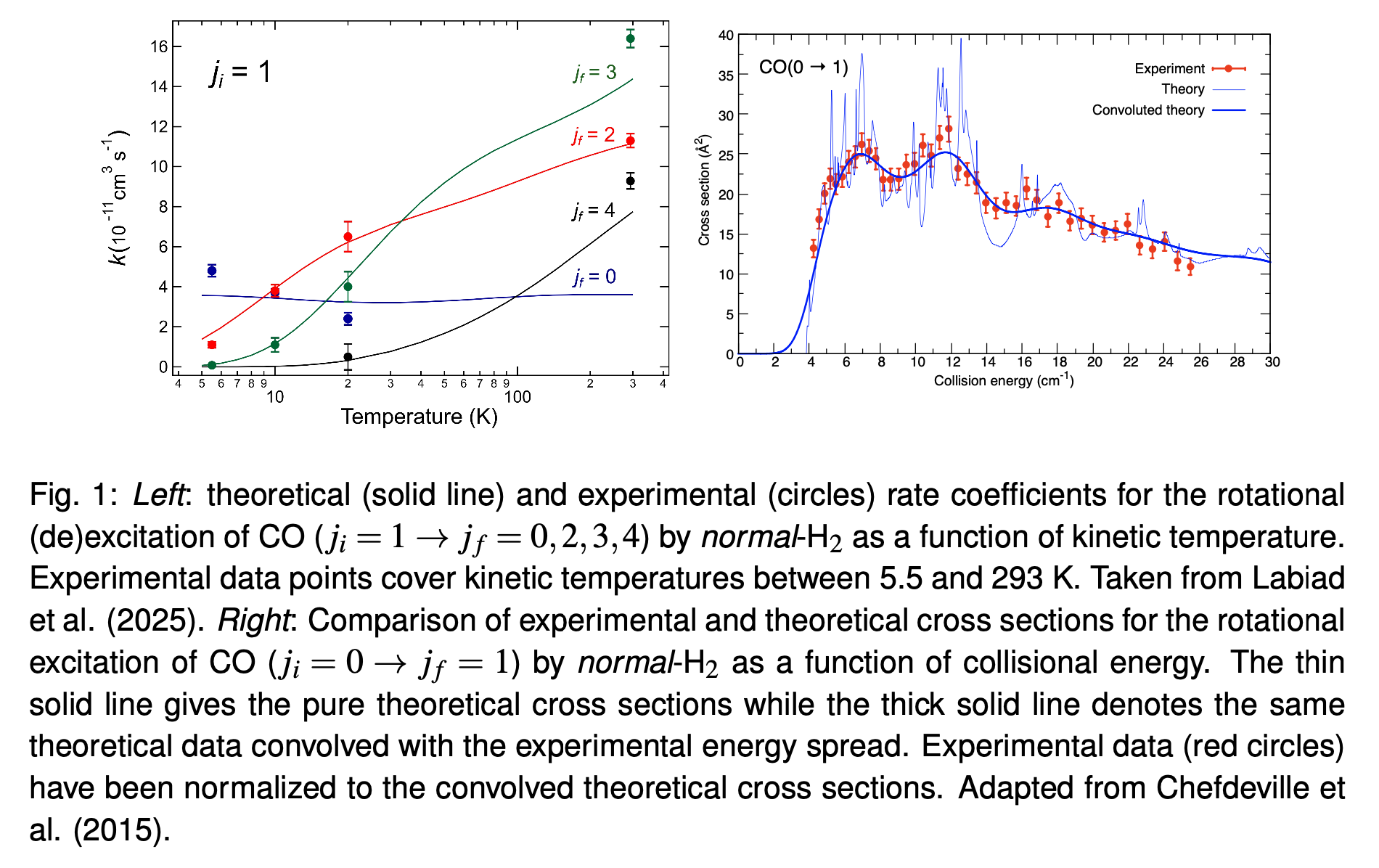
Collisional data in EMAA are taken from theoretical data reported in the literature. Rate coefficients are generally computed using the close-coupling method for atom-molecule and molecule-molecule systems, and the R-matrix approach for electron-molecule systems. As explained in Faure et al. (2025), such gold standard calculations can provide a typical accuracy of 10%. As an illustration, we present in Fig. 1, left panel, theoretical and experimental rate coefficients for the rotational (de)excitation of CO (ji =1 → jf = 0, 2, 3, 4) by normal-H2 as a function of kinetic temperature (Labiad et al. 2025). As expected, a very good agreement is observed between the experiment and the close-coupling calculations, confirming once again (after the validation by the crossed beam measurements of Chefdeville et al. (2015), see Fig. 1, right panel) that the theoretical rate coefficients can be used with complete confidence in the interpretation of CO emission spectra.
The CO−H2 benchmark system exemplifies the theoretical accuracy achieved since the 2000-2010s and, as a result, the general quality of collisional data reported in EMAA, which derive for the most part from rigorous close-coupling calculations and high-accuracy PES. On the other hand, for the most demanding systems (targets with more than 5 atoms or heavy projectiles such as CO) where approximations are necessary, the accuracy will hardly reach 10% but will typically lie between ~ 50 and 100% (see Tonolo (2025), and references therein).
EMAA provides experimentally accurate spectroscopic data and theoretical collisional data with typical uncertainties ranging from 10% to 100%. EMAA also includes references to inelastic scattering measurements in a Section 'Comparison to experiment' of the Comments box, when available. Examples include fine-structure excitation of C(3P), parity changing de-excitation of NO, inversion changing de-excitation of ND3, rotational excitation of CH+, CO, H2O, HDO, D2O.
References
Chefdeville S. et al., ApJ 799 L9 (2015)
Endres C. et al., J. Mol. Spectrosc. 327 95 (2016)
Faure A., Bacmann A., Jacquot R., A&A 700 A266 (2025)
Gordon I. E. et al., J. Quant. Spec. Radiat. Transf. 353 109807 (2026)
Labiad H., Faure A., Sims I. R., Phys. Rev. A 112 062816 (2025)
Motiyenko R. & Margulès L., A&A 699 A348 (2025)
Pickett H. M. et al., J. Quant. Spec. Radiat. Transf. 60 883 (1998)
Tennyson J. et al., J. Quant. Spec. Radiat. Transf. 326 109083 (2024)
Tonolo F., Front. Astron. Space Sci. 12 1713849 (2025)